On Nov. 3rd, Your Vote Can Protect Marion County’s Quality of Life!
VOTE YES TO PROTECT... BEFORE IT’S TOO LATE!
✔ Protect water quality
✔ Improve and repair our parks & save spaces for new parks and trails
✔ Preserve lands from over-development
✔ Improve & protect water resources like springs, rivers, and lakes
✔ Protect wildlife habitat and natural areas before they are lost forever
✔ Save forests and working farms
✔ Ensure accountability, local control, and full public disclosure
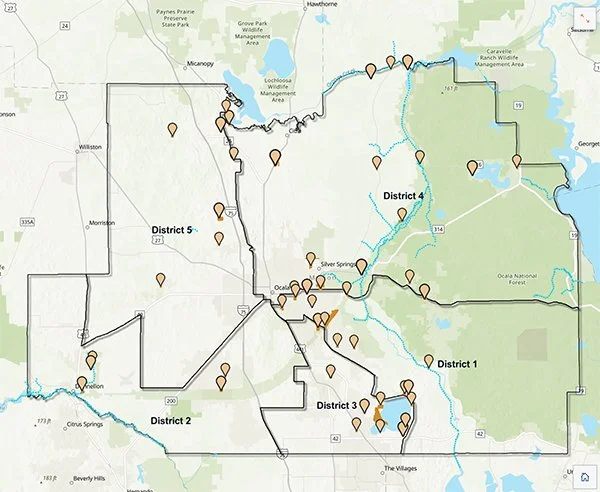
See What’s Planned for Marion County
Browse proposed new parks, upgrades to existing parks, trail projects, and the plan for protecting our land and water. Look up an address or district to find nearby sites, narrow results by project type, and click any marker for its estimated budget, renderings, and early timeline.
Official Ballot Language
MARION COUNTY GENERAL OBLIGATION BOND REFERENDUM FOR PARKS, TRAILS, CLEAN WATER PROTECTION, FARMS AND FORESTS
REFERÉNDUM SOBRE BONOS DE OBLIGACIÓN GENERAL DEL CONDADO DE MARION PARA PARQUES, SENDEROS, PROTECCIÓN DE AGUAS LIMPIAS, GRANJAS Y BOSQUES
To acquire and improve lands and conservation easements for parks, trails, and recreational facilities, preserve and protect natural lands, farms, forests, and quality of drinking water sources, springs, rivers and lakes, shall Marion County issue bonds up to $140 million principal amount, maturing within 20 years of each issuance, bearing interest not exceeding the maximum legal rate, payable from countywide ad valorem taxes not exceeding 0.35 mills, with full public disclosure of all spending?
¿Debería el Condado de Marion emitir bonos por un monto de capital de hasta 140 millones de dólares, con vencimiento dentro de los 20 años posteriores a cada emisión y con intereses que no excedan la tasa legal máxima, pagaderos mediante impuestos ad valorem aplicados en todo el condado que no superen los 0.35 mils, para adquirir y mejorar terrenos y acuerdos de conservación destinados a parques, senderos e instalaciones recreativas, así como para preservar y proteger áreas naturales, granjas, bosques y las fuentes de agua potable, incluidos manantiales, ríos y lagos, garantizando la plena divulgación pública de todos los gastos?
○ Yes / Sí
○ No / No
Marion County’s Quality of Life is on Your Ballot!
Vote YES to Protect Land and Water:
Cast your ballot on or before November 3
✔ Accountability is built in to ensure funds are properly spent.
Public Audits: The program requires that all spending is subject to an annual independent audit that must be made available to the public. These funds can only be used for the identified uses.
Listed Projects: The projects are listed on the county website and are restricted to the uses listed the ballot language which must be approved by voters.
Transparent Selection Projects: The County took a very transparent approach to selecting the projects and made sure they are equitably distributed across the entire county.
Matching funds: The County will seek matching funds from private, state and federal sources to make the local investment go farther. Some Florida Counties are matching farm, forestry and natural land protection funds 4 to 1 (four state dollars for every local dollar).
Cost is capped: A yes vote will cap the annual expenditure at $35 per $100,000 of assessed property value after all exemptions. The average home in Marion County assessed at $155,561 would pay an estimated $54 per year, or $4.50 per month. This is a small price to pay for protecting parks, water quality and natural lands all across our community.
✔ We must protect Marion County’s land, water and quality of life before it’s too late.
Water quality protection: Preserving natural lands helps protect our drinking water supplies, and the quality of water in our rivers, springs, lakes and wetlands.
Reducing flooding: Natural lands hold water during storms, protecting against flooding on roads, in homes and businesses. Preserving lands along waterways across the county will reduce flooding and safeguard water quality.
Managing the negative impacts of development: If we don’t act NOW to preserve our quality of life, much of what we love will be lost forever to over-development. Reducing development in rural and natural areas also helps protect against problems like congestion, flooding, and the demand for new infrastructure.
Something for everyone’s love of our home: Conservation efforts in Marion County will protects natural area for wildlife habitat; it will create nature parks that allow fishing, hiking, boating and other outdoor activities; it will protect working farms and forests, safeguarding our food supply, rural character, horse industry and agricultural heritage; and it will create opportunities for new parks, trails and greenspaces in neighborhoods, to get everyone outdoors for exercise, fun and health. Protecting God’s creation is our responsibility.
✔ We need to improve and repair our parks and save spaces for new parks and trails.
Repair what we already have: Marion County maintains a robust system of over 50 existing parks, many of which need repairs and upgrades. It is important to keep up with basic maintenance for safety, for efficiency, and to protect the investments we’ve already made. Putting off fixing our parks will only increase future costs.
Even distribution of featured projects: The County completed a careful process of evaluating needs, citizens and advisory board members were encouraged to weigh in, and what resulted was a list of projects that will meet needs across Marion County.
Accelerating progress with bonds: The ballot question gives the county authority to bond funds. A bond to the county is like a mortgage to you and me, it enables work to be done sooner so the projects are delivered faster and the cost is spread to future users. Without bonds, building some key projects will take a longer period of time.
Frequently Asked Questions
-
In August 2026, the Marion County Commission approved referring a parks, trails and land conservation bond measure to the November 3, 2026 ballot. If approved by a simple majority of voters (50% plus one), the measure authorizes — but does not require — the County to issue general obligation bonds of up to $140 million to improve and create parks and trails and acquire land and property interests for conservation. The question includes issuing up to 0.35 mills in property taxes ($35 per $100,000 of assessed value after all exemptions) as the funding source.
The County has the option to levy the millage and pay-as-they-go, or could issue bonds in stages, only as specific projects are identified, approved by the Commission, and ready to be completed. If the Commission never issues the full amount — or chooses to fund projects through existing revenues such as impact fees, or state and federal grants instead — it is not obligated to do so. A dedicated local fund would also help Marion County compete for state, federal and private matching dollars available for parks and land conservation, water protection and forestry or farmland preservation that require a local contribution.
-
The Commission held a thorough process to identify needed parks improvements through the county. The project list and an interactive map are located at marionparksconservation.org.
The county has designated 10% to 20% of funds for conservation projects. The intent is expected to be to purchase land and development rights to protect water quality, wildlife habitat, working farms and forests. These lands could help create outdoor recreational opportunities for activities like hiking, boating, fishing, hunting, horseback riding and the like. Some funds may be used to keep working farms and forests productive and in private ownership, but protected from development forever, through a conservation easement. If approved, funds could be matched with private, state and federal funds by Marion County under the direction of the Board of County Commissioners. The adopting resolution requires full public disclosure of project spending.
-
Marion County held a series of four public workshops throughout 2026 to assess conditions and needs for the park system. Marion County maintains over 50 parks, some of which have substantial need for updating of equipment, lighting, and facilities. Other areas need brand new services because of growth or changes in needs. Each Commissioner set priorities for their individual districts, and they were ratified by the entire Board. Citizen committees also reviewed and made suggestions for the project priorities.
-
With the landowner’s approval, members of the public, non-profits, local governments, businesses, and others will be able to nominate lands for conservation using a very brief form. Objective criteria are typically used to rank projects based on the outlined intent of the program.
Examples of outcomes include:
protecting water quality in rivers, lakes, creeks, and drinking water sources;
conserving wildlife habitat and natural areas;
purchasing development rights of working forests and farms, to keep them in production for food, the horse industry, scenic vistas and water protection;
reducing flooding by providing natural storage areas and protecting wetlands and coastal areas; and
providing nature-based outdoor recreation.
Marion County is expecting to use this fund primarily for matching projects primarily funded by state, federal, water management district, private or other programs. The goal is to stretch local dollars as far as possible. Some other Florida Counties, such as Polk, are matching local dollars about four to one: for everyone local dollar they get four dollars for conservation from other sources. In this way, Marion County could turn $20 million in local resources into $80 million total conservation funds.
-
The reason that projects are not identified in advanced is because the process of choosing projects and acquiring land is complex and requires landowner agreements, appraisals of value, boundary surveys, environmental audits, seeking state and federal matching grants and so on. No properties will be acquired without full voluntary agreement of all landowners. For these reasons it is not efficient or cost effective to identify projects in advance of voter approval. It is possible that there will be lands available for sale in the future that are important to protect that aren’t currently for sale. If passed, this referendum will allow the county to act quickly to protect land that would otherwise be developed if and when it is offered for sale.
-
Based on the proposed millage increase which is capped in the ballot language at 0.35 mills, the assessment would be a maximum of $35 per year per $100,000 of assessed property value after any exemptions. The estimate of the most the average homeowner would pay once all the bond are issued is $54 per year or $4.50 per month. This is based on an average homesteaded residential taxable 2026 value in Marion County of $155,621 after all exemptions. To check your own assessed value, you can visit the Marion County Property Appraiser’s website here, click on “Property Search” and enter your address: https://www.pa.marion.fl.us The proposal enables issuance of $140 million in bonds backed by a 0.35 mill property tax increase. Projections are based on conservative calculations such as assuming all the bonds are issued at once in 2027 with an interest rate of 4% and a 20-year term. The calculations provided assume no tax base changes. However, if Amendment 3 reaches the 60% plus one threshold for passage, then the tax impact on the homesteaded properties will decrease. Other assessments could go up, depending on the adopted millage rate and other county obligations.
-
This proposal provides for the bonds and annual expenditures to be paid for through property taxes. Those who do not own land or buildings subject to local property tax will not make direct payments for this purpose. It is possible that renters or customers of property-tax paying landlords or businesses could eventually have some or all the tax passed on through their rents or costs.
-
Use of funds will be restricted to those purposes listed in the ballot language. This proposal would protect farmland and forests by acquiring the rights to develop on them, and would also be used for publicly owned parks, nature preserves and conserved lands. The ballot language requires full public disclosure of all project spending and county government conducts annual independent audits. All decisions will have to be approved by the Marion County Commission in public meetings, which monitors expenditures and provides added transparency.
-
Marion County is one of the fastest growing communities in Florida, and land values are increasing steadily. Aside from the Pennies for Parks Program in place in the 1980’s-90’s, the County has not had a substantial dedicated fund for theirlocal parks and land conservation programs, therefore the County has not been able to compete for state or federal funds for this purpose at the same level as some peer counties. Marion County is part of the Florida Wildlife Corridor containing over 106 thousand unprotected acres of corridor lands, but the intent is to complete parks projects and acquire lands across the county, not limited to the Wildlife Corridor or any other specific location.
-
Yes, there are 25 active county parks and land conservation programs approved by voters in Florida. Nassau, Duval, Clay, Flagler, Volusia, Brevard, Indian River, Martin, Palm Beach, Alachua, Lake, Polk, Osceola, Seminole, Pasco, Hillsborough, Sarasota, Manatee, Charlotte, Lee, and Collier Counties to name just a few, have voter-approved, dedicated funds for parks and land conservation. Already on the ballot for November 2026 are renewals in Sarasota, Charlotte, Manatee and Brevard Counties and new funding sources in St. Johns and Santa Rosa Counties are also on the ballot this year. In the August 2026 primary, Bonita Springs voters passed a $35 million bond for acquisition of land for a trail with 68% support. Over time, Floridians have passed at least 93 ballot measures for parks and land conservation, with 84% passing. TPL has been involved in 46 of those, with an 86% passage rate.
-
If approved by the voters, the bonds will provide up to $140 million for parks and conservation purposes. Marion County would likely apply for matching funds from the State of Florida, the federal government, and private contributors. Most state and federal funding sources require a local match, and without that match Marion County has a difficult time competing for funds. Some counties, like Polk, have been able to match local dollars by more than four to one.
-
If voters approve the bonds, dedicated funding would be assured for parks and land conservation for a long period of time, justifying a sustained effort based on the will of Marion County voters. Bonds would provide the County with funds upfront to be able to acquire lands quickly, and in the future. Placing this measure on the ballot gives Marion County voters a chance to decide whether they want to prioritize improving and expanding parks and trails, preserving water quality and wildlife habitat, farms and forests. This is not a program mandated by state law, so if voters choose not to approve the bonds there is no obligation to fund these efforts in another manner. Under these circumstances, it makes sense to allow voters to decide whether this is a priority for most citizens. The county does have the option to pay back the bonds with the adopted conservation impact fees, existing revenues, or other means. This referendum, if passed, would grant the voters’ approval to issue bonds and levy millage, but if conditions change the County is not obligated to do so.
-
If the measure does not pass, Marion County will not at this time have dedicated funds to improve parks, purchase natural areas and wildlife habitat or to purchase development rights to maintain working forests or farms. Many of these lands would likely be developed. Without the ability of these bonds to provide matching funds, Marion County would be less likely to secure grants from Tallahassee and Washington that require some county contribution.
Those counties that have substantial local parks and land conservation funds almost all use voter-approved mechanisms and compete more effectively for state and federal grants using their local resources.
Across the state, 84% of all such measures have been passed by voters since 1996 (LandVote.org).
-
At 60%, the passing threshold for a constitutional amendment is higher than the 50% needed for a bond referendum in Florida, but almost all city and county governments will need to dramatically cut their budgets if Amendment 3 passes. Based on Florida Association of Counties data, the property tax revenue for Marion County (and most other Florida local governments) will drop so substantially that the County will need to reconsider all budget decisions from top to bottom. This year, six other Florida counties and one city are moving ahead with voter referenda on parks and/or parks and land conservation efforts, but they all have determined that even with passage by voters, Amendment 3 may make the levy difficult at least at first. The authorization is for a 20-year time horizon so if revenues stabilize or are replaced things could change and the program would be ready to go.
-
For years Marion County citizens have approached the County Commission with concerns about the need for parks improvements and the overdevelopment of rural natural land in our community. The County Commission has heard repeatedly from its citizens that something must be done to protect our water quality, wildlife habitat, natural areas, farms, forests and quality of life in the face of development pressure. The County Commission voted unanimously to place a bond referendum on the November ballot, giving Marion County voters a chance to decide whether they want to preserve water quality and wildlife habitat and maintain active agriculture and forestry in our community.
The County Commission formally requested technical assistance from the Trust for Public Land, which has the expertise to evaluate the need, assess the costs and benefits and design a proposed program. This work is funded by Live Wildly Foundation/Bellini Better World with no government support at all. Representatives of other organizations, including sports and conservation groups, have expressed support for the idea.
-
Much of the remaining areas we all see as natural land across our county is privately owned and can legally be developed. Marion County does exceed the statewide average in terms of how much land is in permanent protection from development. According to the Florida Natural Areas Inventory (FNAI.org), Marion County is 37% conserved, most of which is in the Ocala National Forest. The state average amount of protected land is 32%. However, only 0.2% of Marion County consists of local conservation areas, such as nature parks, trails, or water access. In comparison, Volusia is 7.5% locally conserved, Alachua is 6%, and Duval has 4.7% of its land in local conservation status.
-
The question will appear near the bottom of the second page. You can vote at your assigned precinct on election day, by casting your ballot by mail or voting early at seven locations throughout the county from October 22 through 31, 2026, 8 AM to 6 PM. Early voting locations are listed on the County Supervisor of Elections Website, located here: https://www.votemarion.gov/317/Vote-Early
You can cast your ballot at your assigned polling place on Tuesday, November 3. Polls are open from 7:00 AM until 7:00 P.M. For more information you can reach the Supervisor of Elections at votemarion.gov. It will be located near the end of the ballot on the second page.
-
There is a privately funded, citizen-run political committee made up of Marion County residents and conservation advocates, called Protect Marion 2026. The committee is Chaired a local business leader, Lauren Debick, with help from others. No public funding or resources will be used to advocate for or against the ballot measure, but it is legal for citizens, non-profit organizations, businesses and other non-governmental entities to support or oppose this effort.
Protect Marion 2026
3035 Maricamp Road, Suite 104 #112
Ocala, Florida 34471For further information you are welcome to reach out to Lauren Debick, Lauren.Debick@gmail.com, or Pegeen Hanrahan with Trust for Public Land, Pegeen.Hanrahan@TPL.org.
Want to Learn More?
Visit Marion County Parks & Recreation website to learn more details of how this Bond Referendum will help improve the quality of life for all residents.